View Printable Version

David Ingram - A bigger than life human has passed.


Room 709   Palliative Care

Entering the room Mitchell and I hugged. I moved toward the Big Man with difficulty. On the way in Jane and Jose had said David had just gone into a coma.  It made last week's visit of Mary and I more significant.  I reached for the frail hand and I got a groan, not one of pain or fright but the long questioning one emerged.  It was the same plaintiff call I remember 12 kilometers north of the Dempster Highway, the night we camped in open bear and ptarmigan country on one of our many northern trips.  I was sleeping in the Suburban between the built in ptarmigan pens and Ingram was tented outside – on the air mattress and warm bags in the freezing night – but exposed to any visitors. His call was clearly questioning the rustling noises beside the vehicle. Was it a flock of ptarmigan or a bear? he tried to ask quietly. It was still light at 12:30 that early morning. He was trying to quietly assess the visitors. I banged the doors from the inside - a flurry of wings confirmed the willow ptarmigan.

We shared many great trips. My wife has had to accept that my favorite traveling companion was the Big Man. He never complained at camping in unusual sites, at me and my dog taking a 20 hour hike while he occupied himself with local wildlife or vistas. I remember returning down a long treeless tundra valley towards our northern Yukon campsite and scoping the landmark mountain, still more than a mile away, to see an animal moving on the summit. Caribou or bear? As I got below the mountain, at camp it became clear that over 1200 feet up the steep rocky-talus slope was Ingram – totally an anti-gravitational phenomena. It boggled the mind how this 350 pound giant had navigated the steep boulder and slippery mountain. My massive friend sat calmly on the peak. An hour and forty minutes later I joined him to watch a sun traverse the northern sky – a glow that straight lined along the horizon. He never asked for, nor would have accepted had I dared offer, any help.

We hardly ever entered a northern Eskimo or Indian village that within moments Ingram had not found the bone yard, their 40 years of discarded vehicles. He was out of the vehicle with wrenches looking for parts to fit my antique 1970 suburban - driven by the common motor and parts for 20 years - the contents of these scrape yards. We often left the north with more weight of parts than my vehicle weighted. The gathering crowd of locals, adults and kids, always enthusiastically assisted him. Out went more complimentary Bald Eagle books! It was unfortunate the First Nations people did not need tax guides!

But perhaps what was always the highlights of the summer month I shared with Ingram were not the wildlife treasures we saw or even caught, but were the gas or village stops. I knew of every bake shop in the north – he every store selling ice cream. Out was Ingram with a free Tax Guide or eagle book for all, a multitude of questions to find out how the Chief hunted caribou, how the store owner survived the dark winter months, or how a nearby kid, trying to corner a ground squirrel in a culvert, got to school. As I explored the wildlife and native cultures, Ingram questioned the rest of the world. No one escaped. Traveling with David was always exciting, inspiring and so so educational. Yes, my favorite traveling companion is gone but not forgotten.

I met David in the early 1970's, was baffled by this man who one moment was performing a belly flop off the high board or the next day writing a White Paper for the government on some complex tax issue. In another moment he was giving out free advice to people who could not afford tax consultation or finishing up some high profile businessman’s tax from – for a pittance of what his work was worth. He was in heaven, if I dare use this word, when questioning or pontificating on radio, TV, the stage, a gathering or on the web. He was at his best giving.

Indeed, David loved front stage. My initial thoughts on this reflection went: I know many famous people who could largely be measured by their greed; many more of less wealth who were also preoccupied by greed driven pursuits; many others simply trudged on through life and ignored the world's plight and callings for a responsible sustainable world. Fortunately we also know a few who championed for good causes. But no one I ever knew was so devoted to giving freely of himself to others than the Big Man – indeed the Big Man. But despite his attraction to ‘front and center’ I never saw him do a put down to any other person. He always honored persons and perspectives. In all those years I never saw him sell a single book – his tax guides or my eagle book. Giving was the Big Man’s thing.

I have known David and Jose from the beginning, and specifically Peter, Mitchell and Jane since all were in the womb. I could not imagine living with David, except for my treasured month for many years traveling the north to strange places. However, I was so very impressed with how David and Jose attended and cared for their kids – who have been there at these trying but important times. When my wife and I got to adopt a daughter over 22 years ago, we agreed to name the Big Man as Godfather.

I treasure my time and friendship with David Ingram as a highlight of my life. Dear traveling companion and friend, I will miss you.

David Hancock

p.s. a retrospective on David Ingram's life is growing over at www.david-ingram.com - please join us.

View Printable Version

Hancock Sidney Update 4

FROM DAVID HANCOCK:

(Written 2/18/11 at 9:05 p.m. PST)

I got home tonight after a long day dealing with a lot of eagle and bird issues -- and to lots of emails -- which I have yet to get to.  I just spoke with Ian and Lynda/elle on the phone and got a great update. 

While there are lots of images and videos of today none suggest the bird is in difficulty.   In the conversations with Karen and Ian it appears, in spite of common worries, that Pa is behaving very normally.  Sure we know he has a cut or whatever on his neck but I have handled a great many raptors in my life and seen incredible healing jobs that occurred on and by wild raptors.

The point I wish to make is that eagles have evolved for 100's of thousands of years sticking their heads into dead and decayed carcasses.  They live on diseased and decaying meat.  They have evolved an ability to fight off invasive diseases.  Pa has been seen eating and processing food so the cut is at least likely only superficial and does not penetrate the crop. If the crop was torn we would by now see food dripping out the crop wound.  This is not the case. 

While I am not wishing to play down Pa's cut, I think in the long run the risk to both Ma and Pa from the grasses in the nest is greater.  Most raptors have little resistance to Aspergillis fungi.  Their nest cup appears to be grass as in last year's Hornby Island nest that claimed the life of their chick.

Therefore from my perspective, since catching the bird is both stressful and potentially disruptive of the breeding season, I favor leaving the bird heal naturally, as it seems to be doing, and only if the bird is in dire straights and failing, should we seek permission to capture it. 

Just as we as humans should not be taking antibiotics we should not be dispersing antibiotics to various of nature's creatures.  I gather all sorts of suggestions are being offered and I very much appreciate all your concerns -- these magnificent creatures deserve better than humans have dished out to them.  Eagles did not seek such greedy competitors or polluters of their waters and food supply.  But Pa seems to be doing fine and I hope he continues along this path.  So many of you are watching carefully as are the members of our fine ground team in the Sidney -- Victoria area.

They will be reporting to me daily and I will try and keep you all informed.

Much thanks.

David

View Printable Version

Hancock Sidney Update 3

FROM DAVID HANCOCK:

(Written 2/15/11 at 8:23 p.m. PST)

Busy day.  Got a very positive response from MOE suggesting our plans to get confirmation of any potential damage to Pa via video was a great approach.  Ian and Harry were today working at getting the feeding site property permissions and food source lined up.

Then calls this morning from Harry that he had reviewed earlier screen shots (I have not yet seen them) that the day before the neck mark appeared he had seen an intruder at the nest that had an off-cam altercation with Pa.  This was heard and then when Pa next appeared he had the neck mark.  This suggests a possible source of the neck mark -- a wound from an altercation.  This lends some credence to my observations.  Namely that I never could see a line around Pa's neck. I earlier suggested that he had possibly hit a branch while 'attacking a tree' to obtain nesting branches.  The neck mark looks to me far more like a skin tear that dries up and curls the skin and feathers, than a fish line constriction.  However, if Pa was losing ground, his health, it does not matter the cause as much as how we could compensate.  If this mark is from a wound, rather than a restricting fish line, it may well heal and the problem is solved.  Maybe this is happening.

Then later in day Anna and others had captured shots of Pa and Ma at the nest and these showed him in top form  -- but with the neck ring evident.  My joy was seeing his behavior as very robust and normal.  Great postings.

Then tonight, while talking with Karen, she read Lynda's comments only posted moments earlier, on watching the pair while Ian videoed them.  Her point was that both birds were vigorous and appeared healthy.  Wonderful -- the pair seen live and on video and looking very strong and capable.

So I take today as very positive. We should quickly proceed with the feeding site as this will give us some control should the need arise.  We were and are some time from deciding to capture Pa -- this would only be permitted should from good videos confirm that his health was in grave danger.  We are some time from that thankfully but will proceed with continued observations by the keen ground crew -- and with great video captures that equally confirm vigorous health.

Thanks again, ground crew, for the positive reports.

David Hancock

View Printable Version

Hancock Sidney Update 2

From David Hancock: 

(Written 2/14/11 at 10:30 a.m. PST)

What a night.  So much concern about the Sidney Pa.  But let's not get ahead of ourselves.  We still don't know that Pa is handicapped by the 'apparent' line, elastic or cut on his neck. 

This AM I spoke with Harry and when he was carefully watching Pa yesterday and taking the fine detailed images, he was not certain that Pa is suffering from the indentations.  Certainly the marks are disruptive of the feathers but how disruptive of the eagle's behavioral options we are not yet certain.

I have also spoken with Maj of Mountainaire Avian Rescue Society on the Island and she is of the same opinion as I:  we don't like the looks but it does not yet look like a crisis situation.  Our objective is to now try and prevent the crisis with minimal intrusion and work towards Pa being an active breeder this season.  Maj also put me in touch with Angela Kendall of WildArc, the regional wildlife rehaber who would be responsible for the Sidney pair.  Angela and I also had a good talk and review of the circumstances.  She is part of this key notification group.  The mutual key is to get some better assessment of any dangers and damage to Pa from anything that might be hanging around his neck.  Is this apparent neck marking causing Pa problems?

Here is the tentative plan we are working on but this is open to comments and suggestions and ultimate approval by Ministry of Environment biologist, Sean Pendergast in Nanaimo -- who will be part of these notes to keep him informed. The key here is that we cannot interfere with the nest and we should do what we can to assess Pa's potential impairment -- if any. Then, if we come to a conclusion of impairment, we should develop a plan.

I see us needing to develop a duel strategy: try and get Pa to a place where we can better assess via personal observation and video and at the same time use these efforts to set up trapping him if he is in difficulty. Again, the assessment would not impinge on Pa being free but would allow us to gain some better observations and at the same time allow us to condition him to a site for trapping if necessary.

Here is my proposal at this time:

FIRST OPTION:

1. Harry and Ian, the ground team, will asap get a source of large fish carcasses (or road kills) and possibly get a location at a farm I have discussed with them, where this bait can be placed perhaps 50 - 60 feet from a fence and potential blind for observation and photography. The site is to be kept private and away from the public.

2. Daily as needed (or in the dark so the person is not seem) the carcasses would be put up for Pa. If Pa starts to use these then, only then, a canvas? will be placed over the fence to become a hide and better videos can be taken to assess Pa's health and vigor. This is highly likely since the pair have frequently taken road kills in the past.

3. Between the cam observations at the nest, random observations from the territory, and then hopefully close-up observations from this blind, we will be better able to assess Pa.

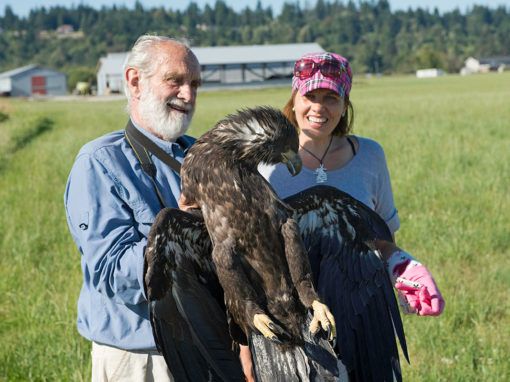
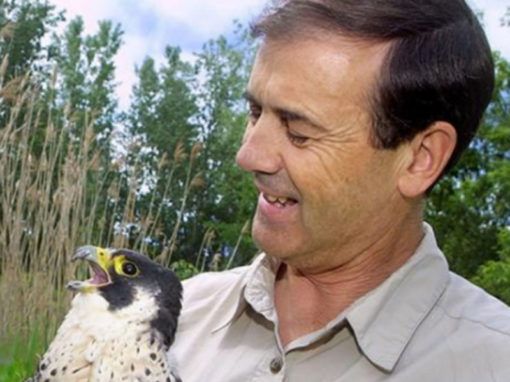
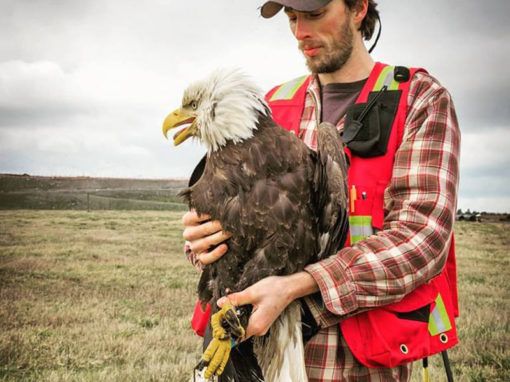
4. Should capture of Pa be necessary due to his deteriorating circumstance, this is authorized under the Rehaber's permits. I would attempt to hire a US bald eagle biologist who regularly traps eagles (in fact Mary and I are going out with him again shortly along the Washington coast to trap peregrines and eagles) and we would get him up here with his nets. We would work with the MOE through all this.

So in conclusion we thank all of you for your observations and concerns and we will try and keep you informed as to what is happening.

Any comments can be posted to the Forum and Karen, my coordinator, will keep me up on key elements. I will try and give some updates as we get this plan in order over the next few days.

As our locals know the area has an inordinate number of non-breeders hanging around southern BC -- they are still trying to find alternative food to the losses of salmon due to the almost non-existent or low salmon runs on most of the Alaska and BC coasts this season. A local farmer presently has 12+ juveniles + a resident pair of eagles feasting on a cow that died giving birth. This is obviously a welcome alternative when fish are scarce. Let's hope the upcoming herring and oolachin runs are high this year.

David Hancock

View Printable Version

Hancock Sidney Update 1

FROM DAVID HANCOCK:

(written 2/14/11 at 1:27 a.m. PST)

As most of you know our Sidney pair have run into some human environmental contaminants -- life threatening fishing line. 

A few days ago Pa seemed to have some feather constrictions around his neck. Some observers thought this might be caused by strands of fish line. At the same time clear, red and green fish lines were apparently draped across the nest in clear view of the cam.  These types of hazards can be lethal and the lines in the Sidney nest are therefore of great concern.

Many of you will have seen images from osprey nests where the young and adults have been lethally but accidentally strangled or tangled.  I have refused to put a cam in a Vancouver Harbor nest that is largely composed of fish lines, net strands and miscellaneous ropes.  The risk of having to witness such a death is not comforting.  Hense my concerns here.

Harry and others are watching the pair and Harry has taken a fine series of still shots that show the riffled neck feathers.  I am hoping that some videos taken away from the nest will give us a better indication of any incapacity or reduced health.  Nest activities should also be closely monitored.  What we are looking for is unnatural behavior, movements that imply the bird is actually incapacitated.

The eagles have lots of hardships thrown their way and only some times can we effectively intervene. I have suggested that our Victoria team establish a fixed place for offering some fish scraps. If the male is having difficulty catching food he will quickly accept these easy offerings -- something these scavengers readily do naturally.

This would enable videos to show the bird's behavior effectively and enable us to evaluate the bird's movements. With so many possibly watching a potential danger grip a bird we all love and admire, it is very easy to get into a rut of seeing "who can sound most concerned and profess the greatest love for the bird". Pretty soon we get demands for actions that are passion driven but not rooted in practical options. I want to explore the practical options effectively.

Our approach at this point should focus on:

A. I will be in touch with key people speaking directly to me.

Harry or Van Island observers to call me with any details and send me direct links to me and Karen. I want direct comments on Pa's activities and if you can organize the feeding station below.

1) Everybody: get the best stills and hopefully videos, nest cams and shots from away from the nest for evaluation.

a. If Karen would please collect all still and video cams that are relevant and pass these along to me.

b. Could Ian please re-focus any pertinent comments on to me.

c. Other key players and our Admins can contact me but concerned outsiders should pass along through to Karen, my project coordinator, so I am not over ridden with calls - karen@hancockwildlife.org

2) Can the Island group give me some feedback on setting up a food offering site near the nest -- probably a slightly remote part of the beach not too visible. This site would give us both a site to evaluate the bird and possibly set up a trapping site to collect the bird if that proved desirable.

Concerns: getting some additional personal and video observations to see accurately the bird's responses to any activities that can be taped. Starting with a feeding station is a good and very natural option. The fish processing plants will likely donate a stream of carcasses. Roadkills are an additional support. The euthanized bunnies of the University would be a good food source along with road kills.

We have a couple of feeding stations presently going on in the valley where the farmers place dead cows dying at giving birth. The eagles need this right now.

This a good start and I will talk with Maj and WildArc on the Island re trapping and possibilities of having to hold for rehab. I recently paid a biologist to come here to view our developing web program and he was telling me of his eagle traps. In fact I will be working with him in early March in Washington State. I just called him. He is qualified to band in Canada, he thinks, and he is available to come up but it costs about $500 per day with all the equipment so we might need to raise a few dollars.

So the plan is in place - let's hope for the best options to emerge. Maybe all will clear up naturally as usually happens -- but we must be prepared.

Thanks.

David

?

Please Donate

Five Easy Ways to Donate to HWF!

Current & Ongoing Promotions


My Account


Sign up as a New User
Lost your password?